Friday, June 13, 2014
A little delayed
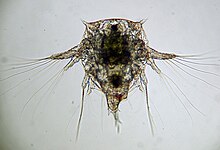
Yup. It's finally time to hit the experiments pretty hard, because I finally have the larvae I need. This is the great time of year, where nearly every female has larvae near-hatching. I took pretty much the same picture for you last year. Except I took it on May 26th. Cold weather = late snails.
Friday, June 6, 2014
Science reading 2: Spillover
I’ve been holding off on writing my next book review for a
couple reasons, but the most important one is that I was finishing the book in
question. I went back and forth about writing the review here. After all, this
is pretty far from marine biology, and surely there are more relevant works I
could point you towards. But this is the latest by my favorite science writer, and in
the end I couldn’t pass it up.
I first encountered David
Quammen at my undergrad institution. He had just published a short
biography of Darwin and was, I guess, on his book tour. We were lucky enough to
snag him as a speaker in our weekly colloquium series. I was doubly lucky in
that I got to go to lunch with him (at the faculty club, so make that triply
lucky). My loss, though, because I’d never heard of him before. Lunch was
interesting, and I remember Quammen telling us some story of boating down the
Amazon, and caimans, and pirahnas, or was it some other river in South America?
His talk was about Darwin’s formulation of the theory of natural selection.
Afterwards there was a book signing and I remember sort of wanting to buy one
but it seemed like an absurd, expensive frivolity. I continue to regret that
decision.
For Christmas that year I got the Darwin biography and a copy of The Song of the Dodo, both amazing, both
long since read. I now own his book on man-eating predators (Monster of God) and one of his several collections of essays from Outside magazine. I’m hoping to write
future posts about these but just in case I never get there, seriously go get
these books. Read them.
Quammen started out in life as a graduate student in
English, studying Faulkner, and it shows. The man can write. He also isn’t
afraid to go anywhere in the world to get a science story, and the more remote,
the better. Best of all, he’s just as interested in the scientists as he is in
their research. His books, therefore, read as a wonderful mix of scientific
fact and cultural anthropology of research scientists. And the science in them
is not just accurate, but not all that simplified. Just explained really well.
I saw Quammen speak a second time in 2012, at the Evolution
meeting in Ottawa. He talked about his soon-to-be-released book, Spillover: Animal Infections and the Next Human Pandemic. He talked about
emerging zoonotic diseases.
He talked about Ebola and walking
through Congolese forests and HIV. There was no book signing, which was just as
well because I’d forgotten mine back in the States.
| Spillover, by David Quammen. The topic really does need a scary cover. |
It’s taken me until this year to read Spillover. I am so glad that I finally did. The book is about
emerging diseases, particularly zoonoses,
or diseases we get from animals. As he says so well, this category includes all
kinds of nasty things: influenza, rabies, hanta, Lyme disease, SARS, AIDS,
Ebola. But this isn’t just a study of the pathology of these diseases in
humans. These diseases come from animals, by definition, and their emergence,
virulence, and duration in the human species is a complicated mix of ecology
and evolution, the story of humans and their altered environments. People
interacting with animals and therefore with their diseases. The take-home
message is that the more often that happens, the more likely a spillover of an
animal virus into a human is, and the more likely that these viruses can be
transmitted human-to-human. These diseases frequently have long evolutionary
histories with their animal hosts, and in many cases are relatively benign. But
in humans, it’s a different story.
Quammen bookends the meaty chapters in the book with the
showstopping diseases: Ebola to start and AIDS to finish. These two are
different in many ways, but similar too. They both seem to come from infected
apes. They both have their origins in Africa. They both have sky-high fatality
rates. In between these two monsters are lots of other diseases, some of which
you know (Lyme, malaria, SARS) and some of which you probably don’t (Hendra,
Nipah, Q fever). I am admittedly squeamish and had to skim the descriptions of
human symptoms for most of these, but the ecological and evolutionary sections
are lengthy and fascinating. For starters, why are so many of these viruses, rather
than bacterial diseases?
This book is scary. I know I never want to be within miles
of a bat in the tropics after reading it. (Spoiler: bats seem to be responsible
for more than their share of these spillovers…or are they? The evidence isn’t
completely clear.) But it ends on a somewhat hopeful note. He does say, based
on interviews with many esteemed disease scientists, that the “Next Big One,”
the next large human pandemic, will almost certainly be a zoonosis. There’s
several reasons for that, discussed at length in the book. We have no idea what
or where or when. But despite that, there are scientists on the case, standing
ready, and working as hard as they can to minimize impact.
I’ll leave you with some of Quammen’s own words:
This whole subject [of zoonotic diseases], like an airborne virus, is at large on the breezes of discourse. Most people aren’t familiar with the word ‘zoonotic’ but they have heard of SARS, they have heard of West Nile Virus, they have heard of bird flu…They are concerned. They are vaguely aware. But they don’t have the time or the interest to consider a lot of scientific detail.
If that describes you, but you have time to read a book, go
get this one. You will get lots of well-written, digestible scientific detail.
Friday, May 16, 2014
Algae and medusae
Spring is still lagging behind, predictably. I went out this morning to find Crepidula eggs to hatch for experiments, and although the eggs are there, they aren't anywhere near hatching. So back to waiting and trying to farm eggs in the lab.
Stuff is definitely happening in the field, though. Most notable since my last trip was a serious explosion of macroalgae. This site is full of really thick growths of large algae through the late spring and early summer, until it gets really hot. The algae is sort of a pain -- it's probably two inches deep to wade through and covers the snails that I'm looking for. At least I was out in boots today, because walking through two inches of algae in my sandals is a little icky.
I did find some snail eggs from other species, including this nifty sand collar.
But by far the coolest thing I saw today was a jellyfish (species unknown). I noticed something funny-looking floating in ALL OF THE ALGAE and at first I just thought it was a dead Chondrus or something. Lots of the algae turns white when it dies. But this seemed to be weirdly radially symmetrical and, upon further inspection, to have tentacles.
Lucky I had my rubber gloves, because I do usually draw the line at handling unidentified jellies.
I was surprised to see this guy so early in the season. The jellies get super-abundant around here by August, but are pretty rare in May. It's also unusual at this particular site to see them washed near shore, though other places I work they are pretty common.
Scyphozoan jellies have a totally awesome life cycle. It has two basic stages: the medusa form (think typical jellyfish) and the polyp form (think sea anemone, to which they are related). A medusa makes gametes that turn into a larva, which grown into a polyp, which then buds into little medusae. Sound complicated? It sort of is. Here's a picture to help.
Stuff is definitely happening in the field, though. Most notable since my last trip was a serious explosion of macroalgae. This site is full of really thick growths of large algae through the late spring and early summer, until it gets really hot. The algae is sort of a pain -- it's probably two inches deep to wade through and covers the snails that I'm looking for. At least I was out in boots today, because walking through two inches of algae in my sandals is a little icky.
| A thick bed of algae on the beach. Normally there's just sand and small cobbles here. The small 'creek' that has been created by flowing water allows you to see just how thick the mat is. |
| A sand collar, or moon snail egg mass. |
Lucky I had my rubber gloves, because I do usually draw the line at handling unidentified jellies.
| Jellyfish! |
Scyphozoan jellies have a totally awesome life cycle. It has two basic stages: the medusa form (think typical jellyfish) and the polyp form (think sea anemone, to which they are related). A medusa makes gametes that turn into a larva, which grown into a polyp, which then buds into little medusae. Sound complicated? It sort of is. Here's a picture to help.
| Life cycle of a scyphozoan. Photo from Wikipedia, with more details. |
My favorite part of this life cycle is strobilation, step 11 in the figure above. Here's a fabulous video. And another one. Something that doesn't come across in the not-to-scale diagram but does in the video is just how small the polyps and strobilae are. They really are fascinating. I haven't ever seen a strobila in the field, but it's on my invert life-list.
For today, though, I'll settle for an adult scyphozoan. And maybe some larval Crepidula, if that's not too much to ask for.
| Today's jelly, adrift in the algae. |
Thursday, May 8, 2014
Science reading 1: Lazy Point
And now for something completely different. No new pictures this week, but I thought I would honor a request: the lovely Carolyn, a high school acquaintance of mine and the literary blogger at Rosemary and Reading Glasses, would like recommendations and reviews of science books.
As it happens, popular science books are among my favorites, so I'm happy to oblige. When I got the request, though, I wasn't quite sure where to start. Aldo Leopold? Rachel Carson? or newer authors like Carl Zimmer and David Quammen? or Stephen Jay Gould? or Neil Shubin? Hopefully I'll get to all of these and more.
But to start, someone who is a contemporary Ph.D. scientist and conservation activist, as well as a relatively prolific writer, filmmaker, and compelling speaker: Carl Safina. Dr. Safina got his Ph.D. at Rutgers studying the ecology of seabirds, and since then has become one of the most public advocates for seabirds, marine mammals, fish, and the marine realm in general. He's also got an appointment at Stony Brook, and I've been fortunate enough to hear his talks and take a course he co-taught in science communication.
Dr. Safina has written several books, and his first, Song for the Blue Ocean, is supposed to be quite stunning. I say 'supposed to be' because my copy is sitting on my bookshelf, embarrassingly untouched. I can wholeheartedly recommend his Eye of the Albatross, in which he travels to an albatross colony in the northwest Hawaiian islands to study the world's largest seabirds.
| Those of you familiar with A Sand County Almanac may recognize the general zeitgeist of the cover of the paperback edition. |
One of the scenes that has stayed with me in the years since I read this is the one where the author encounters poachers of horseshoe crabs. He does an excellent job describing the horror of these crabs being taken en masse, but also explains the economics and politics behind why this happens, as well as the ecological consequences (beyond the mortality to the crabs, there are potential consequences to seabird species that depend on their eggs). It is this description that I return to each time I am out on the shore and fortunate enough to see a female crab buried in the sand.
Interspersed with these snapshots from Lazy Point are chapters where Safina travels to the tropics, the poles, Alaska, and so on to see the global consequences of human impacts on the ecological world. The result is the impression that everything that we do to affect the planet matters, both close to home and far away (even in seemingly untouched, pristine habitats). To quote from the opening pages:
So this story is also about the tension created when those things mistakenly called the "real world" -- though they are entirely artificial -- continually intrude on the real real world. In a real place, the mysteries of ages pile on thick with enduring truths and complex beauties.There is no place, in other words, that is safe from our influence, and no place without its own natural beauty. And later, in those same opening pages, while contemplating migrating seabirds, where they go, where they have been:
They all remind me that the world is both much bigger than Lazy Point, and yet surprisingly small. "I have traveled a great deal in Concord," reported Henry David Thoreau. And how much greater he might have thought his travels if he'd lived at Lazy Point instead. The coast and its migrants bring to Lazy Point a much bigger picture than any map of the place suggests. I sometimes tell friends it's possible to see the whole world in the view from Lazy Point.We are all interconnected with the natural world, and our actions have consequences far away from where we can see. It is a familiar narrative, but the details in this book drive it home.
Monday, April 28, 2014
Hacking spring: what to do when things are slow in the field
Spoiler: spring progress this year is slow. The cyprids continue to settle.
The snails are just starting to come out in the field, and the water is warm enough that the Crepidula are finally brooding eggs. That means that they should be ready for experiments in a few weeks. Until I can reliably collect larvae in the field, I've been making do with what I can farm in the lab. That has meant collecting animals and bringing them up to room temperature, which triggers them to lay eggs. If I keep the females in clear plastic cups, I can watch the embryos develop and collect the larvae when they are ready to hatch.
| An oyster shell (Crassostrea virginica) covered with newly settled barnacles. The redder dots are the younger larvae, and the gray ones are slightly older. |
| A cement wall at my field site. It's hard to tell in this picture, but the reddish tint that you see between the large white pebbles is entirely due to a dense covering of newly settled barnacles. |
Tuesday, April 8, 2014
The barnacle life cycle: a photo essay
In my last post, I talked about the many settling barnacle cyprids that indicated the arrival of spring around here...but without any good photos of what these larvae actually look like. So here is a brief post on the life cycle of a barnacle.
Barnacles are crustaceans, the same group that contains the more familiar crabs and lobsters. This means, among other things, that they have an exoskeleton and jointed appendages. But they live attached to rocks, covered with a calcareous test, with no sign of those appendages (at least when the tide is out!).
When covered with water, though, their jointed legs (cirri) extend from those tests and catch phytoplankton that floats by.
Barnacles are crustaceans, the same group that contains the more familiar crabs and lobsters. This means, among other things, that they have an exoskeleton and jointed appendages. But they live attached to rocks, covered with a calcareous test, with no sign of those appendages (at least when the tide is out!).
| Adult barnacles. Photo from Wikipedia. |
When covered with water, though, their jointed legs (cirri) extend from those tests and catch phytoplankton that floats by.
| Feeding barnacles. The feathery things are the cirri. Still from Wikipedia. |
Because the adults live cemented to rocks, it is the larvae that do most of the dispersing. Barnacle larvae go through many molts in the plankton as a nauplius.
| Nauplius larva. Still Wikipedia. |
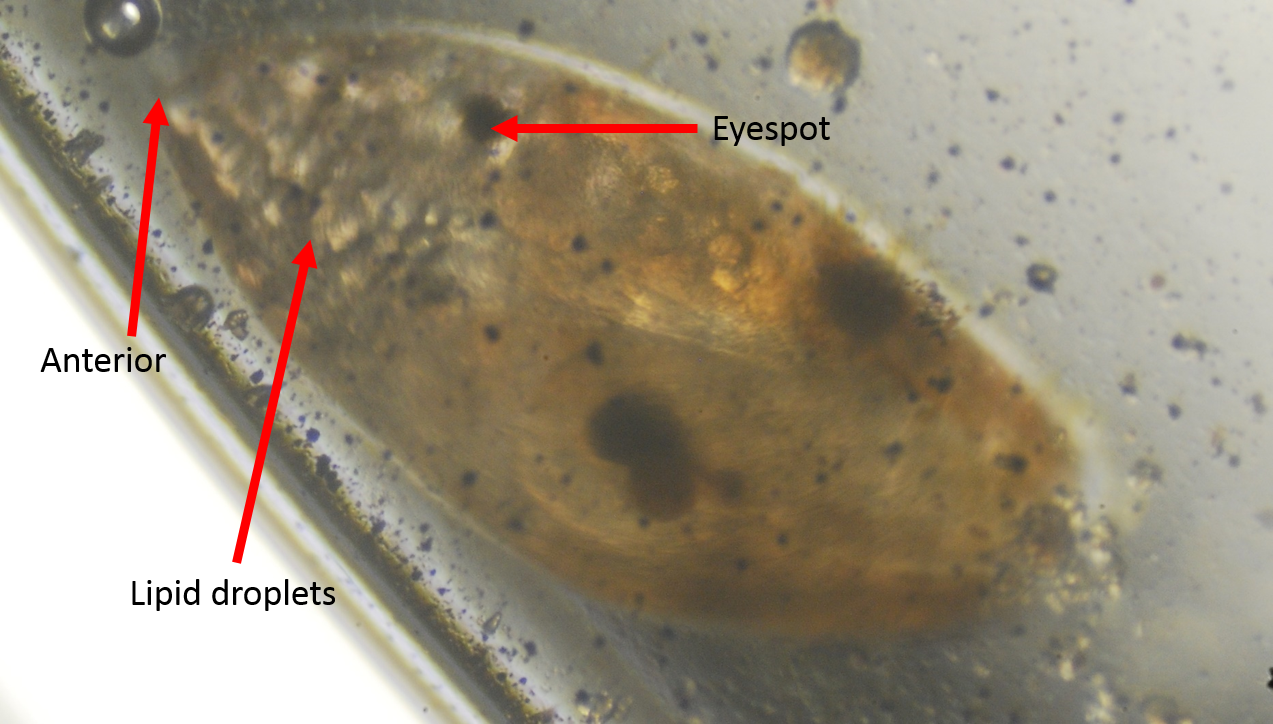
Then, when they are ready to settle and metamorphose, they turn into cyprids. It is these cyprids that search out a place to live, contacting various substrates and searching for the right physical and chemical conditions before metamorphosing into their adult form. Barnacle settlement is ubiquitous in these parts, and relatively easy to settle, so it has been a mainstay of larval ecology for decades. We arguably know more about how and why barnacles choose their settlement sites than any other taxa. It depends on a variety of physical factors (for example, they preferentially settle in cracks on rocks) and chemical factors (they are attracted to proteins produced by conspecifics).
Here is one of the cyprids I collected this weekend.
![]() |
| A cyprid larva. Many lipid droplets at the anterior end provide buoyancy and energy for the larva. |
I have thousands in the lab right now -- if I give them the appropriate settlement cues, I'll be able to watch them metamorphose, and the barnacle life cycle will be complete. (Well, except for gamete production and mating...perhaps left for a future post?)
Sunday, April 6, 2014
All of a sudden, spring
I had a post all planned bemoaning the fact that spring is still very far away in these parts. In previous years, the snails are often laying eggs by this date on the calendar. Given the winter we've all had, it's no surprise that they are still nowhere to be seen, let alone reproductive.
I went to the beach on Tuesday (the day after a freak snow) to bring snails back to the lab for some experiments, and this is what it looked like.
But today everything seemed different. It was the first day I was able to go exploring in shirtsleeves this year, and I went down to the harbor to get seawater for the lab. We don't have running saltwater in my building, but we are close enough to the shore that I can go get it when I need it. I found this.
Cyprids are the last larval stage of a barnacle, and their job is basically to find a place to live as an adult before metamorphosing. They look like little beans with eyes and antennules that they use to sense physical and chemical cues on the substrate. They tend to settle gregariously, preferring to be near other cyprids and adults of the same species.
I went to the beach on Tuesday (the day after a freak snow) to bring snails back to the lab for some experiments, and this is what it looked like.
| The beach on a not-quite-spring morning. The profile of the beach is still very steep due to winter erosion, and there were very few signs of life. |
| Berms of dead Crepidula fornicata shells were everywhere on the beach. That's typical for late winter around here. |
| Cyprids! Each of the brown blurry dots in the water is a larval barnacle, looking for a place to settle. |
| Cyprids, not yet metamorphosed, that have attached themselves to a dead blade of grass. |
Saturday, February 15, 2014
Marine diseases, sea stars, and why it might matter
| A sea star that I found on a collecting trip in September. |
There are several conservation issues in the marine realm that make the news with some regularity. Climate change, of course, and overfishing, and the relative new kid, ocean acidification. But the latest issue that's making headlines is a catastrophic decline in sea star populations along the Pacific coast of North America. This decline is sudden and unexplained, and although the evidence is consistent with a disease, no one really knows yet just what that disease might be.
Yes, marine invertebrates get diseases too. Scientists really know very little about what causes diseases in the marine realm, but we do have examples from coral, lobster, and oysters, just to name a few. It seems like we need to add sea stars to that list. There's even some indication that the frequency of diseases has been rising of late, possibly due to changing climates.
Here are links to places around the web that have explained the current sea star issue better than I can:
PBS recently produced a great clip on News Hour about the problem that I strongly encourage you to see. The scientists interviewed here are ones that I have met and interacted with, and people I really respect. It's neat to see them on TV. In fact, one of them has made a previous appearance on this very blog for her work curating the collection of glass invertebrates at Cornell University.
More scientific information is available here from UCSC. This site shows you the different stages of the disease, and even includes a form for you to report sightings of diseased sea stars (for anyone who might be reading this in the affected Pacific Coast area).
And lastly, here's another great blog post about the subject.
But why does any of this matter? Well, for one thing, sea stars are a group of marine animals that people feel some sort of connection to. They are iconic images of the sea, popping up in jewelry, home decor magazines, and children's cartoons. But they are also important animals in the communities where they occur. Six months ago, I wrote about intertidal zonation on rocky shores. Sea stars are crucial players in keeping mussel beds under control by eating mussels (the stars are pretty voracious predators). In fact, they are the defining example of a keystone species: one that has a disproportionate effect on the community relative to its abundance. Remove the stars from an area, and the whole community structure will change.
So the disappearance of stars due to a mystery disease is pretty troubling. Hopefully scientists can at least figure out what is causing the decline while there are still sea stars left in some of these areas to save.
Tuesday, February 4, 2014
In the bleak midwinter
| My field site under six inches of snow. |
| The high tide line becomes easily visible in the snow: it is where the water has washed the snow away. The beach itself looked normal, until I looked closely. |
It was beautiful this morning, above freezing, sunny, and not windy. A nice break in what is promising to be a very snowy week. Conveniently (since I need the snails), this corresponded to a very low spring tide. Because many of my snails have been frozen off the rocks (see the third picture) I had to venture out into deep enough water that the snails had not been frozen yet this winter.
Thursday, November 14, 2013
Update with snails
I know it's been forever since I updated. The semester started and hit me like the proverbial train, and since then it's been nothing but teaching and research at full-tilt. There was a collecting trip in there, and several experiments started, and a couple finished. I gave an invited talk for the first time at another university, and may have inspired a student to start doing research in ecology.
Here are a few select photos from the last two months:
What inspired me to come back to the blog today was nothing that I have done, but rather this post from Rachel Collin's lab in Panama (I've mentioned their work with Crepidula before). One of the grad students in the lab has gotten actual video footage of mating Crepidula, and the videos are up on the lab blog.
Go. Check it out. It's really quite amazing.
Here are a few select photos from the last two months:
| A tidepool full of Crepidula plana and surrounded by barnacles. Photo taken in September on a collecting trip. |
| My local field site, sunset, early November (the day before the end of daylight savings). |
Go. Check it out. It's really quite amazing.
Subscribe to:
Posts (Atom)